Water Experiments
Over the many years of my work with the control and regulation technology of the human body, I have been searching for the causes of information transfer from person to person outside of the five senses. As a conventional physician and engineer, I don't want to believe, but to know. Since the human body is 70 percent water, it seemed logical to me to attempt to prove this through the medium of water.
Since 2002, I have been investigating how, in my Atlas therapy, information is transmitted to the affected pain process in the body via the TBS impulse (Temporary Brain Splitting). I still assume that the intracellular and intercellular spaces, which are mostly filled with water and surround every cell in the body, play a central role. A striking feature of my experiments at the matter/water/air interfaces is the formation of a repulsion-attraction force field, comparable to the Lennard Jones potential in atomic and molecular physics.
The "pilsner glass experiment" led me to the following questions:
Does water possess a geometric memory?
Can water develop a repulsion-attraction force field (RAF) at its interfaces via antigravity?
Is the behavior of water at interfaces, with the formation of an RAF, the central building block for signal processing?
Is interface water capable of activating antigravitational forces?
Are antigravity and water prerequisites for signal transfer in biological cybernetics?
Are antigravity and water responsible for the design and biocybernetic management of all life forms?
Does the antigravitational force correspond to the differential potential of vacuum energy minus gravitational energy?
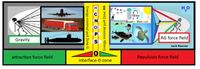
1. Experimental setup: The "pilsner glass experiment" (2005)
.jpg/picture-200?_=197abf051d8)
2. Experimental setup: Pilsner glasses arranged in pairs with markings
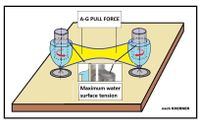
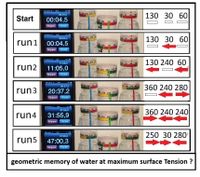
The Kölsch glasses are marked with 360° markers to document the final positions of the rotated Kölsch glasses. The experiment shows that after rotation, the Kölsch glasses assume exactly the same starting position several times and also assume the position shifted by 180° several times.
Video for Experiment 2
The following photos show the process log for the "Pilsner glasses in pairs" experiment. The Kölsch glasses were activated eleven times over a period of three hours. Starting with run five, a magnet was integrated into the setup to eliminate the influence of the Earth's magnetic field.

3. Experiment Setup: Pilsner glasses in groups of three
The setup includes three Pilsner glasses, three Kölsch glasses, one magnet, and a stopwatch (cell phone). As in all other experiments, the Pilsner glasses are filled with water to the point where the Kölsch glasses can center themselves.
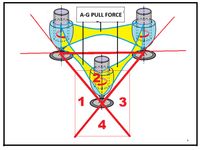
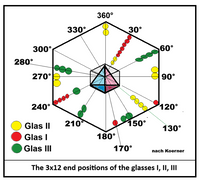
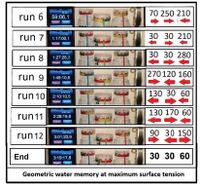
The Kölsch glasses are marked with 360° indicators to document the final positions of the rotating glasses. The experiment shows that the Kölsch glasses come to rest in various positions.
Video for Experiment 3
The following photos show the process log for the "Pilsner glasses in groups of three" experiment. Over a period of 3 hours, the Kölsch glasses were activated twelve times. From run 6 onwards, a magnet is integrated into the experimental setup to eliminate the influence of the Earth's magnetic field.
4. Experimental Setup: Pilsner Glasses Arranged in a Tetrahedral Formation – A Geometric “Water Memory”?
.png/picture-200?_=1996c8971f8)
The experimental setup consists of four pilsner glasses, four Kölsch glasses, a chopstick, a base (glass, vase, etc.), and a stopwatch (cell phone). The Kölsch glasses are marked with different colored flags to document their exact positions. The glasses are arranged in a tetrahedral formation. The numbers 1 to 4 designate the pilsner glasses in the setup. Once the Kölsch glasses have centered themselves within the pilsner glasses due to the “water mound,” they find their starting position.
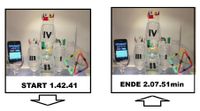
The experiment was started at 1:42:41, as the glasses were at rest at this time. This resting position was observed. At 1:46:27, the Kölsch glasses were rotated one after the other in different directions using a chopstick. The time at 1:48:01 shows the movement of the Kölsch glasses. At the final position of 2:07:51, all Kölsch glasses have come to a standstill. Phenomenon: At the end of the experiment, the Kölsch glasses are exactly in the starting position from 1:42:41! The stable formation of a tetrahedron (4th dimension?) is a valuable aid for the human and biocybernetic design and management of space.

Video on Experimental Setup 4
Conclusion of Experiments 2 to 4
The conclusion of the experiments confirms my hypothesis that the information transfer at the interfaces of the mushroom glass experiments (static) also serves as biological information transfer (dynamic) at the interfaces of intracellular and intercellular spaces.
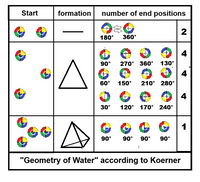
The two- and four experiments demonstrate optimal "water memory" and end precisely at the starting positions. This is an ideal prerequisite for computational power in human cybernetics. The three setup, however, shows no biocybernetically usable structure.
The conclusion of the experiments reinforces my hypothesis that the information transfer at the interfaces of the beer glass experiments (static) also serves as biological information transfer (dynamic) at the interfaces between intracellular and intercellular spaces.
Geometry instead of chemistry
Conventional medicine relies on biochemical messengers. As a human cyberneticist, I see tetrahedral geometry as the "alphabet" of biological control. The formation of a RAK (repulsion-attraction force field) in the behavior of water at interfaces is, for me, the central building block for signal processing. Under certain conditions (interfaces), water forms tetrahedral clusters. These clusters function as a "carrier wave" for the tetragonal signal. The signal is thus not a mere electrical impulse, but a spatial oscillation configuration.
A tetragonal spatial signal is, for me, the fundamental unit of communication, the most stable and efficient spatial form for information transfer in biological systems. The picosecond dynamics in the water sheath of DNA, mentioned by Elsässer, serve, in my opinion, to transport precisely these tetragonal patterns of order. Only when a signal oscillates in this specific tetragonal spatial form can it resonate with the DNA and cell structures.
In Atlas medicine, the TBS impulse is transmitted to the brain via a biocybernetic network. The brain's "control center" (especially the brainstem and the limbic system) acts as a receiver, scanning these tetragonal spatial signals. As soon as a signal is deformed, deviating from the ideal tetragonal shape, the brain recognizes this as "misinformation" (e.g., "pain") and initiates regulatory measures.
5. Experimental Setup: Human vs. Magnet in the Hydrokinetic Information Field
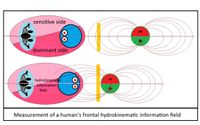
All living beings are equipped with a gravity-sensitive control area, which in its simplest form extends beyond cell boundaries as a reflexive protective zone. This zone can manifest as an energy field ranging from weakly energetic to trongly energetic.
The experimental setup shown in the video includes one large glass bowl, one collection tray for overflowing water, two small glass bowls, two iron spheres, one magnet inside the glass (serving only as a holding mechanism), and the person (standing on the left in the video). Fill the large glass bowl with water to just below the rim, place the iron spheres in one of the small glass bowls, and then place the small glass bowls on the surface of the water in the large glass bowl. Now carefully continue filling the large glass bowl with water until a "water mound" forms at its rim. Only under this condition does a repulsion-attraction force field form on the water's surface, allowing the small glass bowls containing the iron balls to detach from the rim of the larger glass bowl.
Video of Experimental Setup 5
Result of the experiments: "Measuring device for external energy fields"
The "Measuring device for external energy fields" is registered as a utility model with the German Patent and Trade Mark Office (DPMA) under file number 20 2025 002 727.1 on September 18, 2025.
The "Measuring device for measuring external energy fields" has a wooden body. Inside the body is a slot for a measuring rod. The aluminum measuring rod includes a handle, a scale, and a bar magnet. The device also consists of a PVC collection tray, a large glass bowl, a small glass bowl, and a small iron ball (in contrast to the experimental setup, the second small glass bowl and the second iron ball were omitted in the final design).
To ensure accurate assembly, fill the large glass bowl with water as follows: Fill the glass bowl with water to just below the rim, place the iron ball in the small glass bowl, and then place the small glass bowl on the surface of the water in the large glass bowl. Now carefully continue filling the large glass bowl with water until a "water mound" forms at the rim. Only under this condition will a repulsion-attraction force field form on the water's surface, allowing the small glass bowl with the iron ball to detach from the rim of the large glass bowl.
