Around the World on the "Barefoot Route"
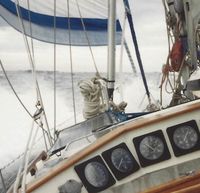
Start and Finish: Aprilia Marittima, Italy
(Aprilia Marittima is located between Venice and Trieste and is now the largest marina in Europe.)
Route: Italy, Greece, Sicily, Tunisia, Sardinia, Menorca, Mallorca, Ibiza, Gibraltar, Morocco, Lanzarote, La Palma, Caribbean Sea, Venezuela, Panama, San Blas Islands, Samoa, Tonga, Fiji, Vanuatu, Australia, Bali, Malaysia, Thailand, Sri Lanka, India, Oman, Djibouti, North Yemen, Eritrea, Egypt, Israel, Cyprus, Greece, Italy
A Circumnavigation Under the Flag of Alternative Medicine
(Quotes from Pain-Free Through Human Cybernetics)
It was the 1990s, and my orthopedic practice was doing well. Everything was perfect, really. But as a mechanical engineer and physician, I wanted more. Suddenly, success as a doctor wasn't enough for me anymore. I was also interested in other natural healing methods and wanted to understand how they worked. And then there was this deep connection to the element of water, which is also reflected in my life story.
As early as age 15, I signed on with the Willy H. Schliecker shipping company in Hamburg – as a crew member on the "Marga," a real "cockroach steamer." Initially, I was a cabin boy there until I began an apprenticeship as a marine engineer. This gave me ample opportunity to explore the world aboard large ships. And even during my subsequent mechanical engineering studies, I regularly went on long voyages. Only at some point, I preferred sailing my own sailboat to motor vessels.
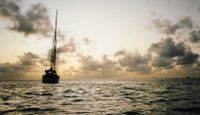
So it came to pass that in September 1992, I abruptly sold my practice in Ottobrunn and set sail. For six years, I traveled the world: from Italy to Gran Canaria, Trinidad and Tobago, and on to Venezuela. Then through the Panama Canal, across the South Pacific towards Australia, Thailand, and Egypt, and through the Suez Canal back to the Mediterranean. That's how I sailed around the globe.
This grand voyage gave me the opportunity not only to study the healing methods of indigenous peoples. It was always important to me to test whether my own method of human cybernetic energy impulse could also help other cultures around the world, or whether it was even practiced elsewhere. A few selected stops on my sailing trip illustrate my experiences with these foreign cultures quite well.
Family consultation on Antigua
%20-%20Kopie_1.jpg/picture-200?_=199b3f0b240)
The journey from the Canary Islands across the Atlantic towards Panama is long. Christopher Columbus had already discovered this on his second major voyage in 1493. For him, the Lesser Antilles opened up as a gateway to the Caribbean. The great explorer landed off Antigua, the main island of what is now the small nation of Antigua and Barbuda.
I, too, was delighted when land finally came into view. Urgent maintenance work forced me to have my yacht towed ashore. At a shipyard in English Harbor, it was put on blocks, and I personally oversaw the repairs. During this time, I noticed a shipyard worker who was limping badly. When I asked him why, he told me about an accident that had occurred over a year earlier. Although his injured foot had been treated at the time, he was still clearly in pain.
I quickly examined his foot, but it showed no abnormalities. I then attempted to erase the man's "pain memory" using a human cybernetic energy impulse. It worked. The worker was immediately pain-free. Incredulous, he initially paced slowly back and forth, jumped up and down a few times, and finally leaped around my boat in joy, shaking his head in amazement.
The next morning, I awoke to a dull thumping against the hull. What could that be? Work at the shipyard hadn't started yet; it was too early. But the knocking continued. Sleepily, I climbed out of my bunk onto the deck—and couldn't believe my eyes. Eleven people were lined up beside my yacht: men, women, and two children, led by the very same shipyard worker I had treated the day before.
He had brought his entire family to the dock to show them the man who had so wonderfully relieved his pain. I was now to treat three more family members who were also suffering from pain. The others had come to watch. What an open-air clinic on the Caribbean shipyard grounds!
Forbidden Shore Leave in Fiji
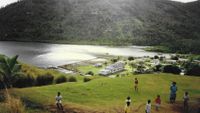
In the middle of the South Pacific, between Samoa and Fiji, my boat was suddenly caught in a hurricane. "Keli" was the first recorded hurricane, forming in the South Pacific during the off-season in June 1997. I learned via shortwave radio from the German Weather Service that the eye of the hurricane, only forty miles away, was moving directly in line with my yacht. Forced to anchor, I did so in a bay off the island of Tuvuca. This was against the rules, as the island belongs to the Lau Group, an archipelago in Fiji, which at that time could only be entered with special official permission. Given the raging hurricane approaching ever closer, obtaining such permission was out of the question. For me, it was a matter of sheer survival. It was impossible to sail another 200 nautical miles west to obtain the necessary permission to dock at one of the islands on the main island of Fiji.
For a whole week, I was forced to stay ashore due to the storm. But I used the time to examine some schoolchildren. The class teacher had learned from the island chief that I was an orthopedic doctor.
There, for the first time, I saw a child who was clearly suffering from depression. The child received widespread affection from all sides. Family and friends cared for the child intensively. Because, unlike in the Western world, the islanders understand that emotional wounds need a lot of attention, that they must be taken seriously, and that they shouldn't be hidden.
After thoroughly explaining the principles of my treatment method to the parents, I was able to successfully treat the child using human cybernetic therapy. The emotional distress disappeared, and the child became happy again.
On my continued tour through the South Pacific, I deliberately visited only sparsely populated islands where people rely on their own medical care. I was struck by the fact that physical wounds weren't treated with much fanfare. They were expected to heal on their own. This was in stark contrast to mental health issues, which were treated with great respect and supported by the community.
I had even more reason to celebrate: As thanks for the successful treatment, the island chief sent a positive report to the customs office in the capital. This saved me from a hefty fine, which could have been as high as €10,000. Incidentally, a general navigation permit now applies to the waters surrounding all Fiji islands – including the Lau group.
Human Cybernetics in Arabic
From Down Under, my journey continued past Indonesia, Sri Lanka, and India to the Arabian Peninsula. During a stay in the port city of Salalah in southern Oman, I was invited by the head physician of the Sultan Qaboos Hospital. I was to hold a two-week human cybernetics consultation there. However, on the fourth day, I was asked to end the consultation. The clinic had become too crowded. What had happened? Word had quickly spread that a doctor was treating patients who didn't require them to remove their clothing or face veils. For the predominantly Muslim population with their strict religious precepts, this was a true blessing.
After the consultation was cut short, I was even asked if people could attend my consultation in Germany. Chartering a plane wouldn't be a problem. But at that time, I still had eight months of travel ahead of me, and opening a new practice was out of the question.
In the Face of Death
From the Sultanate of Oman, it's just a stone's throw to Yemen. Sailors usually travel in convoy through the Red Sea – close to the African coast, heading towards the Suez Canal. But my crew and I decided to go it alone along the Arabian coast, because I was interested in visiting some of the islands offshore. I should have reconsidered.
Heading for remote islands without having thoroughly researched the political and regional situation beforehand carries the risk of getting caught in the crossfire of a war zone. And that's exactly what happened to us. Off the west coast of Yemen, near the Hanish Islands, we found a sheltered bay to anchor in front of Jazirat Jabal Zuqar Island. Too late, we noticed numerous military bunkers ashore. Although we immediately weighed anchor and, thanks to the powerful 130 hp diesel engine, headed full speed ahead towards the open sea, we were still caught in a shelling. What we didn't know: Our yacht was right in the middle of the ceasefire zone between Yemen and Eritrea.
Although already in international waters, a speedboat approached. With a Kalashnikov at the ready, its crew made it unmistakably clear that we should return to the island. Just moments before, I had at least managed to send out a distress call about piracy via shortwave radio. A Dutch merchant ship picked up the message and relayed it to Germany. The German ambassador to Yemen, Helga von Strachwitz, was informed of the incident.
No sooner had my yacht anchored than it was surrounded by several small boats. I was ordered to go ashore. The thought flashed through my mind that I could be executed there—in front of relatively few witnesses—so I vehemently refused and promptly felt the barrel of a Kalashnikov against my forehead.
It was strange, but at that moment I wasn't afraid at all. Anyone who knows me knows about my fighting spirit. I'm not one to back down easily and sometimes I'm determined to get my way. But in this case, I was also certain that my counterpart, with his blank expression, wouldn't hesitate to pull the trigger at the slightest signal from his superior. And suddenly I realized that this time I should use the insights of my human cybernetic method to my own advantage.
Take it down a notch and talk calmly to the superior! This advice, which I usually give my patients when they feel threatened by someone with a higher energy level, may well have saved my life in Yemen. Because the moment I turned my sensitive side towards the gun-wielding assailant and stopped looking him directly in the eye, the situation eased somewhat.
Shortly afterward, another boat arrived. Its commander, a converted former British citizen, first checked the passports of my crew and me and then granted us safe passage out of the danger zone.
The selected stops along the six-year circumnavigation are just a few examples that impressively demonstrate how the human cybernetic energy impulse can have a positive impact anywhere in the world – almost like a therapeutic Esperanto.
The content is constantly being expanded. Please visit the page again soon. Thank you for your interest!