"From Idea to Implementation"

If someone else's idea is adopted and presented as one's own without citing the source, it's simply disrespectful, a blatant case of "idea theft." Ideas are not protected by copyright.
Only when they become concrete (e.g., as text, a utility model, a patent, or a prototype) can they be protected. Fortunately, the idea for my individually adjustable pillow concept with an integrated, movable neck roll has had registered priority since 2010, was patented in 2013, and received utility model protection for a specific sleeping pillow variant.
atlas-medLINE - a pillow that "thinks for you"!
In In my orthopedic practice, I observed many people with similar ailments: The main symptoms were often tension, headaches, and neck pain. This was reason enough to investigate the underlying causes of the increased localized muscle tension. The mobility of the cervical spine is 50% controlled by the atlas, the first cervical vertebra. Instead of an intervertebral disc connecting to the second cervical vertebra, the atlas joint is articulated across four joint surfaces, free of stress. This led to a closer examination of the "suspension" of the freely floating first cervical vertebra, the atlas. This "floating" first cervical vertebra is held in place by an extensive network of muscles and ligaments, including the outer neck muscles and the smaller muscles surrounding the atlas. Unilateral strain on these muscles, such as cramped seating on airplanes and long car journeys, or even lying in a recliner at home, requires the atlas to constantly counteract this strain in order to keep important blood vessels open. Such a head tilt results in asymmetrical tension due to the typical arrangement of the atlas ring muscles, which can lead to painful, reversible disorders. The orthopedist's clear conclusion: a special pillow was needed.
Among the overabundance of neck pillows, neck cushions, and bolsters promising relaxation, no "variable" pillow could be found—none that could adequately adapt to the constantly changing pressure on the cervical spine when at rest. The first prototypes of what would later become the atlas-medLINE pillows were thus created.
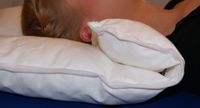

During the pillow's development phase, the combined expertise of engineering and medicine proved invaluable once again. Longtime colleagues from the fields of technology and medicine served as advisors and consultants, navigating the complexities of patent law. This lengthy process ultimately led to the granting of a patent by the European Patent Office and the potential for commercialization.
For the initially envisioned fabric options, a dedicated family business from Hesse supported me, thus overcoming the hurdle of initial production. My most important partners during the testing phase were my patients, even the youngest ones!

Especially in children, the already considerable strain on the cervical spine is exacerbated in an inclined sleeping position due to the existing imbalance between the weight of their head and their still-developing neck muscles. In inclined sleeping positions, the atlas-medLINE pillow guarantees active movement while simultaneously preventing the head from being bent at an extreme angle.

Testing Phase of the First Fabric Pillows
The key features of the pillow concept were the movable neck roll and the adjustable amount of filling to ensure individual adaptation to the anatomical requirements of the cervical spine.


The neck roll was attached to the upper part of the pillow either with Velcro or by lateral fastening straps.
All pillows in the test series were numbered by our development company to allow for easy identification of the test subjects.

Testing Phase of the First Air Cushions
It quickly became clear that this cushion, in an inflatable version, would be the ideal travel and beach companion. The search began for a manufacturer, which I found in Bavaria and whose expertise I relied on. Despite high production costs, I was very keen on Germany as the production location.
My test subjects were thrilled with the versatility of the inflatable cushion; when folded up small, it fit into any piece of luggage or beach bag. But unfortunately, complaints piled up. When one patient repeatedly complained about leaky seams on an air cushion, but, convinced of the concept, exchanged the cushion five times, I discontinued production. Thousands of euros down the drain – the learning experience of a 70-year-old "young entrepreneur"...

First Production in Bavaria