Dr. Herbert Koerner                        
Engineer - Doctor - Circumnavigator

Free from Pain?

Pain in Europe  (Quotes from Pain-Free Through Human Cybernetics)

Pain in Europe (Quotes from Pain-Free Through Human Cybernetics)
On average, one in five Europeans suffers from frequent or constant pain:
This most commonly affects Norwegians, Poles, and Italians, with about one in four adults affected. Statistically, the Spanish are the least pain-prone, with "only" around eleven percent of the population complaining of pain.
This is the conclusion of the "Pain in Europe" study, probably the most comprehensive survey on pain in Europe to date. Over 46,000 people were interviewed, including 5,000 chronic pain patients. The study estimated the economic losses incurred annually across Europe due to the absence of people suffering from chronic pain at at least 34 billion euros.
Source: Pain in Europe Survey, NFO World Group, October 2002–June 2003
www.schmerzmessen.de/daten-fakten/schmerzen-in-europa.htm
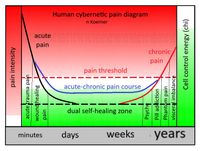
Pain Is Not Objectively Measurable

One problem continues to puzzle doctors: pain is difficult to measure. Nevertheless, doctors need reliable indicators of the current intensity of a patient's discomfort. Keeping a pain diary can be helpful in this regard. For example, since the end of 2012, the "Pain Initiative" has been informing those affected about the importance of a pain scale as a simple yet effective tool using a short film. The film can be viewed online at the initiative's website, www.schmerzmessen.de. The pain scale presented there is as simple as it is ingenious: it is essentially a ten-centimeter-long slider on which the person affected rates their current pain level between "no pain" and "most imaginable pain." The exact "value" of the pain intensity can then be read on the back of the scale. Pain should be measured several times a day in this manner, and the results recorded in a pain diary, which therapists can then use as a guide. 

If it is possible to precisely investigate the regulatory principles of pain processes in the body, it could also be deduced how, in chronically ill patients, the increasingly pronounced pain pathways can be virtually reversed through human cybernetic treatment.